The Enemy Alliance
Al-Aḥzâb
الاحزاب
Surah Al-Aḥzâb for kids content

LEARNING POINTS
- •
This surah talks about Allah's help to the believers, especially in the most difficult times.
- •
The first section of this surah tells us about the enemy forces that tried to attack the Muslims in Madinah.
The Muslims protected their city by digging a trench.
- •
The believers are promised great rewards and the hypocrites are warned of a horrible punishment.
- •
The surah provides social guidelines for adoption, divorce, modesty, and the manners of dealing with the Prophet (ﷺ) and his wives.
- •
Allah and His angels shower blessings on the Prophet (ﷺ), and the believers are asked to do the same.
- •
The surah talks about the excellence of the Prophet (ﷺ) and his family.
- •
Those who keep their promises to Allah are promised a great reward.
- •
Humans (and jinn) have free will, unlike the rest of Allah's creation.
ORDERS TO THE PROPHET
1O Prophet!
'Always' keep Allah in mind, and do not obey the disbelievers and the hypocrites.
Surely Allah has perfect knowledge and wisdom.
2Follow what is revealed to you from your Lord.
Surely Allah is fully Aware of what you 'all' do.
3And put your trust in Allah, because Allah is enough to take care of 'everything'.
يَٰٓأَيُّهَا ٱلنَّبِيُّ ٱتَّقِ ٱللَّهَ وَلَا تُطِعِ ٱلۡكَٰفِرِينَ وَٱلۡمُنَٰفِقِينَۚ إِنَّ ٱللَّهَ كَانَ عَلِيمًا حَكِيمٗا1
وَٱتَّبِعۡ مَا يُوحَىٰٓ إِلَيۡكَ مِن رَّبِّكَۚ إِنَّ ٱللَّهَ كَانَ بِمَا تَعۡمَلُونَ خَبِيرٗا2
وَتَوَكَّلۡ عَلَى ٱللَّهِۚ وَكَفَىٰ بِٱللَّهِ وَكِيل3

BACKGROUND STORY
- •
There was an idol-worshipper named Jamil ibn Ma'mar, who was an enemy of Islam.
Many people thought he had two hearts (or minds) because of his great ability to understand and memorize.
He used to brag, 'With each of my two hearts, I can understand far better than Muhammad (ﷺ)!
'
- •
However, when the idol-worshippers were badly defeated at the Battle of Badr, Jamil was the first to run away in shock.
When he arrived in Makkah, he was wearing one shoe and carrying the other.
People asked him why, and he said, 'Oops!
I thought I was wearing both shoes!
' This is when people realized that he didn't actually have two hearts.
According to verse 4, Allah doesn't create a person with two hearts.
BACKGROUND STORY
- •
Before the time of the Prophet (ﷺ), there was a common type of divorce called `zihar`.
If a man compared his wife to his mother by saying, 'You are as unlawful to me as the back of my mother,' his wife would be divorced.
Islam banned this type of divorce (58:3-4).
- •
Also, long before Muhammad (ﷺ) became a prophet, he adopted a son named Zaid, who became known as Zaid ibn Muhammad.
Later, adoption was banned, and Zaid's name changed back to Zaid ibn Harithah.
According to verse 4, just like someone can't have two hearts/minds, a person can't have two fathers (a real father and an adopted father) or two mothers (a
real mother and a wife compared to a mother).

WORDS OF WISDOM
- •
Someone may ask, 'Adoption is a good thing, so how come it is forbidden in Islam?
' The word `tabanni` can be understood in two different ways—one of them is encouraged in Islam; the other is not allowed.
- •
Sponsorship is encouraged.
A person can sponsor a child or host them in their home and care for them as they care for their own children, with some legal differences.
For example, sponsored children must keep their last names and are not entitled to a share in the inheritance of their adopted parents, but can receive a donation
through a will.
- •
The Prophet (ﷺ) said that the person who sponsors an orphan will be very close to him in Jannah.
This shows the great reward for this act.
{Recorded by Imam Al-Bukhari}
- •
What is not allowed is a type of adoption where a person takes an orphan and gives them his/her last name or gives them a share of inheritance
similar to their own children.
RULES ON DIVORCE AND ADOPTION
4Allah does not put two hearts in any man's chest.
In the same way, He does not consider your wives as your real mothers, 'even' if you say they are.
And He does not consider your adopted children as your real children.
These are only claims.
But Allah declares the truth, and He guides to the 'Right' Way.
5Let your adopted children keep their family names.
That is more just in the sight of Allah.
But if you do not know their fathers, then they are 'simply' your fellow believers and close friends.
There is no blame on you for what you do by mistake, but 'only' for what you do intentionally.
And Allah is Forgiving and Merciful.
مَّا جَعَلَ ٱللَّهُ لِرَجُلٖ مِّن قَلۡبَيۡنِ فِي جَوۡفِهِۦۚ وَمَا جَعَلَ أَزۡوَٰجَكُمُ ٱلَّٰٓـِٔي تُظَٰهِرُونَ مِنۡهُنَّ أُمَّهَٰتِكُمۡۚ وَمَا جَعَلَ أَدۡعِيَآءَكُمۡ أَبۡنَآءَكُمۡۚ ذَٰلِكُمۡ قَوۡلُكُم بِأَفۡوَٰهِكُمۡۖ وَٱللَّهُ يَقُولُ ٱلۡحَقَّ وَهُوَ يَهۡدِي ٱلسَّبِيلَ4
ٱدۡعُوهُمۡ لِأٓبَآئِهِمۡ هُوَ أَقۡسَطُ عِندَ ٱللَّهِۚ فَإِن لَّمۡ تَعۡلَمُوٓاْ ءَابَآءَهُمۡ فَإِخۡوَٰنُكُمۡ فِي ٱلدِّينِ وَمَوَٰلِيكُمۡۚ وَلَيۡسَ عَلَيۡكُمۡ جُنَاحٞ فِيمَآ أَخۡطَأۡتُم بِهِۦ وَلَٰكِن مَّا تَعَمَّدَتۡ قُلُوبُكُمۡۚ وَكَانَ ٱللَّهُ غَفُورٗا رَّحِيمًا5
GUIDELINES FOR THE BELIEVERS
6The Prophet is closer to the believers than they are to each other.
And his wives are their mothers.
As written by Allah, close relatives have more right to 'inherit from' one another than 'other' believers and emigrants, unless you want to' show kindness to your 'close'
friends.
This is decided in the Book.
ٱلنَّبِيُّ أَوۡلَىٰ بِٱلۡمُؤۡمِنِينَ مِنۡ أَنفُسِهِمۡۖ وَأَزۡوَٰجُهُۥٓ أُمَّهَٰتُهُمۡۗ وَأُوْلُواْ ٱلۡأَرۡحَامِ بَعۡضُهُمۡ أَوۡلَىٰ بِبَعۡضٖ فِي كِتَٰبِ ٱللَّهِ مِنَ ٱلۡمُؤۡمِنِينَ وَٱلۡمُهَٰجِرِينَ إِلَّآ أَن تَفۡعَلُوٓاْ إِلَىٰٓ أَوۡلِيَآئِكُم مَّعۡرُوفٗاۚ كَانَ ذَٰلِكَ فِي ٱلۡكِتَٰبِ مَسۡطُورٗا6
PLEDGE TO DELIVER THE TRUTH
7And 'remember' when We took a pledge from the prophets, as well as from you 'O Prophet', and from Nuh, Ibrahim, Musa, and 'Isa, son of Maryam.
We did take a serious pledge from 'all of' them
8so that He may question these men of truth about 'delivering the' truth.
And He has prepared a painful punishment for the disbelievers.
وَإِذۡ أَخَذۡنَا مِنَ ٱلنَّبِيِّۧنَ مِيثَٰقَهُمۡ وَمِنكَ وَمِن نُّوحٖ وَإِبۡرَٰهِيمَ وَمُوسَىٰ وَعِيسَى ٱبۡنِ مَرۡيَمَۖ وَأَخَذۡنَا مِنۡهُم مِّيثَٰقًا غَلِيظٗا7
لِّيَسَۡٔلَ ٱلصَّٰدِقِينَ عَن صِدۡقِهِمۡۚ وَأَعَدَّ لِلۡكَٰفِرِينَ عَذَابًا أَلِيمٗا8
BACKGROUND STORY
- •
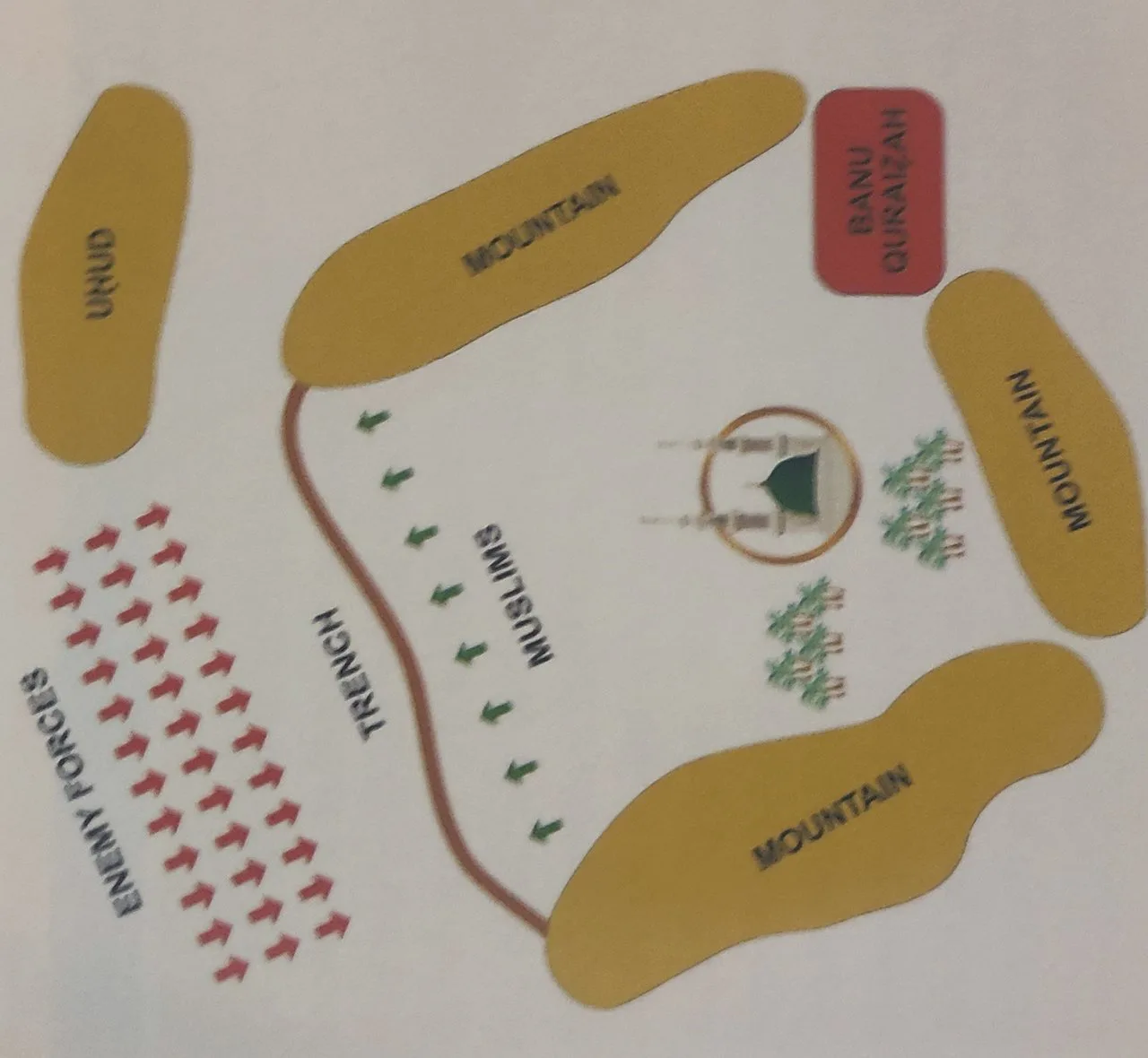
In the 5th year after Hijrah, the Prophet (ﷺ) received news that the Makkan idol-worshippers were gathering a large army of over 10,000 soldiers to attack the Muslim
community in Madinah, which had only 3,000 soldiers.
- •
The Prophet (ﷺ) consulted with his companions for suggestions.
Salman Al-Farisi (R.
A.
), a Persian companion, suggested digging a trench to protect the city, a tactic that was unknown in Arabia at the time.
The Prophet (ﷺ) and his companions began digging day and night, despite bad weather, little food, and no rest.
- •
Within six days, the Muslims were able to dig a five-kilometer-long, five-meter-deep, and ten-meter-wide trench in the rocky land to the north of Madinah.
When the enemy forces arrived, they were in total shock.
For almost a month, they surrounded Madinah but could not cross the trench, with the Muslims defending it with arrows from the other side.
- •
During this difficult time, hypocrites in the Muslim army started leaving one by one, claiming their homes were unprotected.
Things got even worse when the enemy forces convinced the Jewish tribe of Banu Quraizah to break their peace agreement with the Muslims and join the enemy.
- •
This was a terrifying time for the Muslim community.
Some asked the Prophet (ﷺ), 'We are so scared that our souls are jumping into our throats.
Is there a prayer we can say?
' The Prophet (ﷺ) replied, 'Yes!
Say, 'O Allah!
Cover our weaknesses and calm our fears.
' Eventually, the enemy forces were forced to leave because of strong winds and horrible weather conditions.
This event is known as the Battle of the Trench or the Battle of the Enemy Forces.

SIDE STORY
- •
For days, the Prophet (ﷺ) and his companions were digging the trench with almost no food.
The Prophet (ﷺ) was so hungry that he had a rock tied to his stomach.
- •
One of his companions, Jabir ibn 'Abdillah (R.
A.
), asked his wife to make some food for the Prophet (ﷺ).
She only had a little goat and some flour, so she told Jabir to invite only the Prophet (ﷺ) and one or two companions.
- •
When Jabir (R.
A.
) told the Prophet (ﷺ) about the small meal, he made a public announcement that Jabir (R.
A.
) had prepared food for everyone.
The Prophet (ﷺ) then told Jabir (R.
A.
) to ask his wife to keep the bread in the oven and the meat in the pot.
His wife was shocked when the Prophet (ﷺ) arrived with a large crowd.
- •
The Prophet (ﷺ) recited a blessing on the food before it was served in groups.
Not only did everyone eat until they were full, but extra food was left for Jabir's family and for others.
This was one of the many miracles of the Prophet (ﷺ).
WORDS OF WISDOM
- •
To say that the Prophet (ﷺ) was just another man is like saying that a diamond is just another stone.
He is the best man that ever walked this earth.
He was selected to receive the Quran and chosen to be the final messenger.
- •
One of the reasons why the companions loved the Prophet (ﷺ) so much was because of his humility.
They always felt that he was one of them—their brother and best friend.
When it was time to build the mosque, he was carrying bricks with them.
When it was time to dig the trench, he was digging with them.
When they were hungry, he was the last one to eat.
- •
He was there for their weddings, funerals, and everything in between.
This is why they were willing to stand up for him and sacrifice for his cause.
- •
The Prophet (ﷺ) asked for his companions' opinions and suggestions, even though he didn't need to, since he was receiving revelations from Allah.
But he wanted to teach them to discuss with each other during his life so they could make decisions after his death.
The concept of `shura` (consultation) is mentioned in 42:38 as one of the qualities of the true believers.

THE BATTLE OF THE TRENCH
9O believers!
Remember Allah's favour upon you when 'enemy' forces came to 'attack' you in Madinah', so We sent against them a 'violent' wind and forces you could not see.
' And Allah always sees what you do.
10Remember' when they came at you from east and west, when your eyes stared 'in horror' and your hearts jumped into your throats, and you had 'all sorts
of' thoughts about Allah.
11Then and there, the believers were 'seriously' tested and were deeply shaken.
يَٰٓأَيُّهَا ٱلَّذِينَ ءَامَنُواْ ٱذۡكُرُواْ نِعۡمَةَ ٱللَّهِ عَلَيۡكُمۡ إِذۡ جَآءَتۡكُمۡ جُنُودٞ فَأَرۡسَلۡنَا عَلَيۡهِمۡ رِيحٗا وَجُنُودٗا لَّمۡ تَرَوۡهَاۚ وَكَانَ ٱللَّهُ بِمَا تَعۡمَلُونَ بَصِيرًا9
إِذۡ جَآءُوكُم مِّن فَوۡقِكُمۡ وَمِنۡ أَسۡفَلَ مِنكُمۡ وَإِذۡ زَاغَتِ ٱلۡأَبۡصَٰرُ وَبَلَغَتِ ٱلۡقُلُوبُ ٱلۡحَنَاجِرَ وَتَظُنُّونَ بِٱللَّهِ ٱلظُّنُونَا۠10
هُنَالِكَ ٱبۡتُلِيَ ٱلۡمُؤۡمِنُونَ وَزُلۡزِلُواْ زِلۡزَالٗا شَدِيدٗا11
BACKGROUND STORY
- •
When the Muslims were digging the trench to protect Madinah, they came across a solid rock they couldn't break.
They told the Prophet (ﷺ), so he took a spade and hit the rock three times.
- •
Each time the rock was smashed, it created sparks of fire while the Prophet (ﷺ) shouted 'Allahu Akbar' (Allah is the Greatest).
When asked why he said 'Allahu Akbar', he said, 'When I hit the rock the first time, I saw the palaces of Persia.
When I hit it the second time, I saw the palaces of Rome (in Syria).
And when I hit it the third time, I saw the gates of Yemen.
'
- •
The Prophet (ﷺ) then added that the angel Jibril (A.
S.
) had just told him that Muslims would take over Persia, Syria, and Yemen.
This was a miraculous prophecy from Allah, but the hypocrites started to say, 'He is telling us that we will beat these powerful kingdoms, and we can't even
go outside the city to use the washroom!
'
- •
Not long after the death of the Prophet (ﷺ), the Muslim rule spread even beyond these three kingdoms, covering a huge empire that stretched from China in the
east to the Atlantic Ocean in the west, including all of North Africa and parts of Europe like Turkey and Spain.
ATTITUDE OF THE HYPOCRITES
12And remember' when the hypocrites and those with sickness in their hearts said, "Allah and His Messenger have promised us nothing but illusion!
"
13And 'remember' when a group of them said, "O people of Yathrib!
There is no point in you staying 'out here, so go home!
" Another group of them asked the Prophet's permission 'to leave', saying, "Our homes are unprotected," while 'in fact' they were not unprotected.
They just wanted to run away.
14And if their city was invaded from all sides and they were asked to leave their faith, they would have done it almost in no time.
وَإِذۡ يَقُولُ ٱلۡمُنَٰفِقُونَ وَٱلَّذِينَ فِي قُلُوبِهِم مَّرَضٞ مَّا وَعَدَنَا ٱللَّهُ وَرَسُولُهُۥٓ إِلَّا غُرُورٗا12
وَإِذۡ قَالَت طَّآئِفَةٞ مِّنۡهُمۡ يَٰٓأَهۡلَ يَثۡرِبَ لَا مُقَامَ لَكُمۡ فَٱرۡجِعُواْۚ وَيَسۡتَٔۡذِنُ فَرِيقٞ مِّنۡهُمُ ٱلنَّبِيَّ يَقُولُونَ إِنَّ بُيُوتَنَا عَوۡرَةٞ وَمَا هِيَ بِعَوۡرَةٍۖ إِن يُرِيدُونَ إِلَّا فِرَارٗا13
وَلَوۡ دُخِلَتۡ عَلَيۡهِم مِّنۡ أَقۡطَارِهَا ثُمَّ سُئِلُواْ ٱلۡفِتۡنَةَ لَأٓتَوۡهَا وَمَا تَلَبَّثُواْ بِهَآ إِلَّا يَسِيرٗا14
WARNING TO THE HYPOCRITES
15They had already promised Allah earlier never to turn their backs 'and run away'.
And a promise to Allah must be answered for.
16Say, 'O Prophet,' "Running away will not help you if you 'try to' escape a natural or violent death.
'If it is not your time,' you will only be allowed to enjoy life for just a short time.
"
17Ask 'them, O Prophet', "Who can put you out of Allah's reach if He wants to harm you or show you mercy?
" They can never find any protector or helper other than Allah.
وَلَقَدۡ كَانُواْ عَٰهَدُواْ ٱللَّهَ مِن قَبۡلُ لَا يُوَلُّونَ ٱلۡأَدۡبَٰرَۚ وَكَانَ عَهۡدُ ٱللَّهِ مَسُۡٔولٗا15
قُل لَّن يَنفَعَكُمُ ٱلۡفِرَارُ إِن فَرَرۡتُم مِّنَ ٱلۡمَوۡتِ أَوِ ٱلۡقَتۡلِ وَإِذٗا لَّا تُمَتَّعُونَ إِلَّا قَلِيل16
قُلۡ مَن ذَا ٱلَّذِي يَعۡصِمُكُم مِّنَ ٱللَّهِ إِنۡ أَرَادَ بِكُمۡ سُوٓءًا أَوۡ أَرَادَ بِكُمۡ رَحۡمَةٗۚ وَلَا يَجِدُونَ لَهُم مِّن دُونِ ٱللَّهِ وَلِيّٗا وَلَا نَصِيرٗا17
HYPOCRITES' EVIL ACTIONS
18Allah knows well those 'hypocrites' among you who discourage 'others from fighting', saying 'secretly' to their brothers, "Stay with us," and who themselves hardly participate in
fighting.
19'They are' totally unwilling to help you.
When danger comes, you see them staring at you with their eyes rolling like someone who is about to die.
But once the danger is over, they tear you up with sharp tongues, because they are' hungry for 'war' gains.
Such people have not 'really' believed, so Allah made their deeds worthless.
And that is easy for Allah.
۞ قَدۡ يَعۡلَمُ ٱللَّهُ ٱلۡمُعَوِّقِينَ مِنكُمۡ وَٱلۡقَآئِلِينَ لِإِخۡوَٰنِهِمۡ هَلُمَّ إِلَيۡنَاۖ وَلَا يَأۡتُونَ ٱلۡبَأۡسَ إِلَّا قَلِيلًا18
أَشِحَّةً عَلَيۡكُمۡۖ فَإِذَا جَآءَ ٱلۡخَوۡفُ رَأَيۡتَهُمۡ يَنظُرُونَ إِلَيۡكَ تَدُورُ أَعۡيُنُهُمۡ كَٱلَّذِي يُغۡشَىٰ عَلَيۡهِ مِنَ ٱلۡمَوۡتِۖ فَإِذَا ذَهَبَ ٱلۡخَوۡفُ سَلَقُوكُم بِأَلۡسِنَةٍ حِدَادٍ أَشِحَّةً عَلَى ٱلۡخَيۡرِۚ أُوْلَٰٓئِكَ لَمۡ يُؤۡمِنُواْ فَأَحۡبَطَ ٱللَّهُ أَعۡمَٰلَهُمۡۚ وَكَانَ ذَٰلِكَ عَلَى ٱللَّهِ يَسِيرٗا19
PARANOID HYPOCRITES
20They 'still' think that the enemy forces have not 'yet' withdrawn.
And if the enemy forces ever came 'again', the hypocrites 'would wish' to be far away in the desert among the roaming Arabs, 'only' asking for news about
you 'believers'.
And if the hypocrites were with you, they would hardly take part in the fight.
يَحۡسَبُونَ ٱلۡأَحۡزَابَ لَمۡ يَذۡهَبُواْۖ وَإِن يَأۡتِ ٱلۡأَحۡزَابُ يَوَدُّواْ لَوۡ أَنَّهُم بَادُونَ فِي ٱلۡأَعۡرَابِ يَسَۡٔلُونَ عَنۡ أَنۢبَآئِكُمۡۖ وَلَوۡ كَانُواْ فِيكُم مَّا قَٰتَلُوٓاْ إِلَّا قَلِيل20
WORDS OF WISDOM
- •
If you read the life story of the Prophet (ﷺ), you will be filled with love and respect towards him.
He was the best father, the best husband, the best teacher, and the best leader.
- •
He came as a mercy to the whole world to teach people how to be grateful to their Lord.
He was born in a cruel society that abused women and the poor, and he stood up for them and gave them rights.
- •
He lost his parents at a young age and became the best parent.
He was an orphan himself, and he promised great rewards to those who take care of orphans.
- •
He forgave his enemies, so he won their hearts.
Even though he was the greatest prophet, he was very humble with his companions.
He was very honest, wise, gentle, brave, patient, and generous.
According to verse 21, he is the best example for all Muslims to follow.
WORDS OF WISDOM
- •
Someone may ask, 'What did the Prophet (ﷺ) look like?
' Many companions described him, including an old woman named Umm Ma'bad, who said:
- •
“I saw a handsome man with a bright face.
He is perfectly formed, not fat or skinny.
He is not too short or too tall.
He has beautiful eyes with long eyelashes and perfect eyebrows.
His hair is dark, his neck is long, and his beard is full.
”
- •
“He is fascinating when he speaks and honorable when he is quiet.
His speech is very clear and sweet.
He doesn't speak too little or too much.
Words come out of his mouth like pearls.
He doesn't frown or criticize.
”
- •
“He has companions who are always there for him.
They listen when he speaks and obey when he orders.
”

THE PROPHET AS A ROLE MODEL
21Surely you have in the Messenger of Allah an excellent example for whoever has hope in Allah and the Last Day and remembers Allah often.
لَّقَدۡ كَانَ لَكُمۡ فِي رَسُولِ ٱللَّهِ أُسۡوَةٌ حَسَنَةٞ لِّمَن كَانَ يَرۡجُواْ ٱللَّهَ وَٱلۡيَوۡمَ ٱلۡأٓخِرَ وَذَكَرَ ٱللَّهَ كَثِيرٗا21
BACKGROUND STORY
- •
Anas ibn An-Nadr (R.
A.
) was a great companion who missed the Battle of Badr.
He made a pledge: 'If I attend another battle, I'll prove to Allah how faithful I am!
'
- •
A year later, the idol-worshippers of Makkah came to attack the Muslims in Madinah, so the Muslim army met them by the mountain of Uhud.
At first, the Muslims were winning, so the archers left their positions on the hill, thinking the war was over, even though the Prophet (ﷺ) had told them
not to leave no matter what happened.
- •
This gave Khalid ibn Al-Walid (R.
A.
), who was not a Muslim at that time, a golden opportunity to attack the Muslims from the back.
Many Muslims panicked and started to run away.
A few brave people like Anas ibn An-Nadr (R.
A.
) stood their ground.
- •
Eventually, Anas ibn An-Nadr (R.
A.
) died as a `shahid` (martyr) with more than 80 wounds all over his body.
Verse 23 of the Quran was revealed to honor the sacrifice of Anas (R.
A.
) and other martyrs like him.
WORDS OF WISDOM
- •
There are two different types of `shahids` (martyrs) in Islam: Those who die defending their faith and country, like Anas (R.
A.
) and Hamzah (R.
A.
).
They are treated as `shahids` in this life and the next.
In this life, their bodies are not washed or shrouded, and no funeral prayer (`janazah`) is offered for them.
In the Next Life, Allah will reward and honor them as `shahids`.
- •
The second type includes those who die defending themselves, their home, family, or wealth.
They will be treated as `shahids` in the Next Life, but in this world, their bodies will be washed, shrouded, and `janazah` prayers will be offered for them.
This also includes people who die from drowning, a house collapse, a fire, a disease such as cancer or Covid-19, a car accident, or any painful death.
The Prophet (ﷺ) also said that a woman who dies giving birth to her child is a `shahid`.
ATTITUDE OF THE BELIEVERS
22When the believers saw the enemy forces, they said, "This is what Allah and His Messenger promised us.
The promise of Allah and His Messenger has come true.
" And this only increased them in faith and submission.
23Among the believers are men who have kept the promise they made to Allah.
Some of them have honoured their pledge 'with their lives', while others are waiting 'their turn'.
They have never changed 'their promise' in any way.
24It all happened' so Allah may reward the faithful for their faithfulness, and punish the hypocrites if He wants or show them mercy.
Surely Allah is Forgiving and Merciful.
وَلَمَّا رَءَا ٱلۡمُؤۡمِنُونَ ٱلۡأَحۡزَابَ قَالُواْ هَٰذَا مَا وَعَدَنَا ٱللَّهُ وَرَسُولُهُۥ وَصَدَقَ ٱللَّهُ وَرَسُولُهُۥۚ وَمَا زَادَهُمۡ إِلَّآ إِيمَٰنٗا وَتَسۡلِيمٗا22
مِّنَ ٱلۡمُؤۡمِنِينَ رِجَالٞ صَدَقُواْ مَا عَٰهَدُواْ ٱللَّهَ عَلَيۡهِۖ فَمِنۡهُم مَّن قَضَىٰ نَحۡبَهُۥ وَمِنۡهُم مَّن يَنتَظِرُۖ وَمَا بَدَّلُواْ تَبۡدِيلٗا23
لِّيَجۡزِيَ ٱللَّهُ ٱلصَّٰدِقِينَ بِصِدۡقِهِمۡ وَيُعَذِّبَ ٱلۡمُنَٰفِقِينَ إِن شَآءَ أَوۡ يَتُوبَ عَلَيۡهِمۡۚ إِنَّ ٱللَّهَ كَانَ غَفُورٗا رَّحِيمٗا24
DEFEAT OF THE ENEMY FORCES
25And Allah drove back the disbelievers with their rage, totally empty-handed.
And Allah saved the believers from fighting.
Allah is always Powerful and Almighty.
26And He brought down those People of the Book, who supported the enemy forces, from their own forts and put horror into their hearts.
You 'believers' killed some, and took others captive.
27He has also caused you to take over their lands, homes, and wealth, as well as lands that you have not yet set foot on.
And Allah has power over all things.
وَرَدَّ ٱللَّهُ ٱلَّذِينَ كَفَرُواْ بِغَيۡظِهِمۡ لَمۡ يَنَالُواْ خَيۡرٗاۚ وَكَفَى ٱللَّهُ ٱلۡمُؤۡمِنِينَ ٱلۡقِتَالَۚ وَكَانَ ٱللَّهُ قَوِيًّا عَزِيزٗا25
وَأَنزَلَ ٱلَّذِينَ ظَٰهَرُوهُم مِّنۡ أَهۡلِ ٱلۡكِتَٰبِ مِن صَيَاصِيهِمۡ وَقَذَفَ فِي قُلُوبِهِمُ ٱلرُّعۡبَ فَرِيقٗا تَقۡتُلُونَ وَتَأۡسِرُونَ فَرِيقٗا26
وَأَوۡرَثَكُمۡ أَرۡضَهُمۡ وَدِيَٰرَهُمۡ وَأَمۡوَٰلَهُمۡ وَأَرۡضٗا لَّمۡ تَطَُٔوهَاۚ وَكَانَ ٱللَّهُ عَلَىٰ كُلِّ شَيۡءٖ قَدِيرٗا27
How to study Surah Al-Aḥzâb with children
Use this children's lesson as a guided path: read the short explanation, look at the Arabic verse, listen to related recitation, and return to the full surah when
your child is ready for more detail.
Parents can review one section at a time, ask the child to repeat the main idea, and then continue with the next part or a nearby surah.
This keeps the lesson connected with Quran reading, audio, and daily practice.